


Congratulations from President Obama
President Barack Obama congratulates the NASA JPL MSL/Curiosity rover team and brings his own unique brand of comedy to his message by recognizing the NASA “Mohawk” guy and Curisoity’s search for “Martians.” He also thanked JPL for helping to inspire young people around the world to see how cool STEM (Science, Technology, Engineering, and Mathematics) can really be!
Here’s the complete transcript of the call!
DR. ELACHI: Good morning, Mr. President.
THE PRESIDENT: Who am I speaking with?
DR. ELACHI: This is Charles Elachi, the director of JPL. And we have a room full of the mission operation personnel. This is “Curiosity” Mission Operation on Mars.
THE PRESIDENT: Well, it is great to talk to all of you. And I just want you to know that we could not be more excited about what you’ve been doing.
Somebody asked me the other day whether you’ve already found Martians. (Laughter.) I told them we have to give you a little bit of time. But we know you’re all hard at work and you’re getting some well-deserved rest after a successful landing. And I just wanted to call and say congratulations to the entire Mars Science Laboratory team, and really all of JPL, on last Monday’s incredible success.
Through your dedicated efforts, “Curiosity” stuck her landing and captured the attention and imagination of millions of people not just across our country, but people all around the world, including Times Square. And what you did on Mars was incredibly impressive. Those 76 pyrotechnics going off in perfect succession and the 500,000 lines of code working exactly the way you guys had ordered them — so it’s really mind-boggling what you’ve been able to accomplish. And being able to get that whole landing sequence to work the way you did is a testimony to your team.
I especially want to congratulate Charles Elachi, the head of JPL; the entry descent and landing lead, Adam Steltzner, who helped devise the final step of this amazing descent — the Sky Crane System. What you’ve accomplished embodies the American spirit, and your passion and your commitment is making a difference. And your hard work is now paying dividends, because our expectation is that “Curiosity” is going to be telling us things that we did not know before and laying the groundwork for an even more audacious undertaking in the future, and that’s a human mission to the Red Planet.
I understand there’s a special Mohawk Guy that’s working on the mission. (Laughter.) He’s been one of the many stars of the show last Sunday night. And I, in the past, thought about getting a Mohawk myself — (laughter) — but my team keeps on discouraging me. And now that he’s received marriage proposals and thousands of new Twitter followers, I think that I’m going to go back to my team and see if it makes sense. (Laughter.)
DR. ELACHI: That’s going to be the new fashion at JPL. (Laughter.)
THE PRESIDENT: It does sound like NASA has come a long way from the white shirt, black dark-rimmed glasses and the pocket protectors. (Laughter.) You guys are a little cooler than you used to be. (Laughter.)
As all of you know, my administration has put a big focus on improving science and technology, engineering and math education. And this is the kind of thing that inspires kids across the country. They’re telling their moms and dads they want to be part of a Mars mission — maybe even the first person to walk on Mars. And that kind of inspiration is the byproduct of work of the sort that you guys have done.
So not only do I want to congratulate the team, I want to call out a few of the leaders of the group, including Adam, but also Peter Theisinger, Richard Cook, John Grotzinger, John Grunsfeld. And I’d like to congratulate and thank all of our international partners — Spain, Russia, Germany, France, Canada, Italy, Japan, Australia — all of them contributed, I know, to the instrumentation “Curiosity” landed on Martian surface — and all the scientists who are part of the JPL team.
So you guys have done an outstanding job. You made us all proud. You’ve made NASA proud. You guys are examples of American know-how and ingenuity, and it’s really an amazing accomplishment. So we can’t wait to start hearing back from “Curiosity” and finding out what’s going on. We’re fortunate to be part of a society that can reach beyond our planet and explore frontiers that were only imagined by our ancestors. So it’s inspiring to all of us.
I’m going to give you guys a personal commitment to protect these critical investments in science and technology. I thank you for devoting your lives to this cause. And if, in fact, you do make contact with Martians, please let me know right away. (Laughter.) I’ve got a lot of other things on my plate, but I suspect that that will go to the top of the list. (Laughter.) Even if they’re just microbes, it will be pretty exciting. (Laughter.)
DR. ELACHI: Well, thank you, Mr. President. And on behalf of all us at NASA, we thank you for taking the time to give us a call. And, hopefully, we inspired some of the millions of young people who were watching this landing. Thank you again.
THE PRESIDENT: Well, you’ve already inspired us, but I know that the photographs that are going to start coming back are going to be remarkable and amazing. And, again, you guys should be remarkably proud. Really what makes us best as a species is this curiosity that we have and this yearning to discover and know more, and push the boundaries of knowledge. And you are perfect examples of that, and we couldn’t be more grateful to you.
So, congratulations. Keep up the great work.
Innovations in Space
In 2009, our Astrobiology class group included the space elevator in our presentation on the future of space exploration and colonization. As Curiosity sends images and data back to Earth, we will be preparing for the next steps in planetary exploration that will include Mars. The 2012 Space Elevator Conference will be held August 25-27 at the Museum of Flight in Seattle Washington.
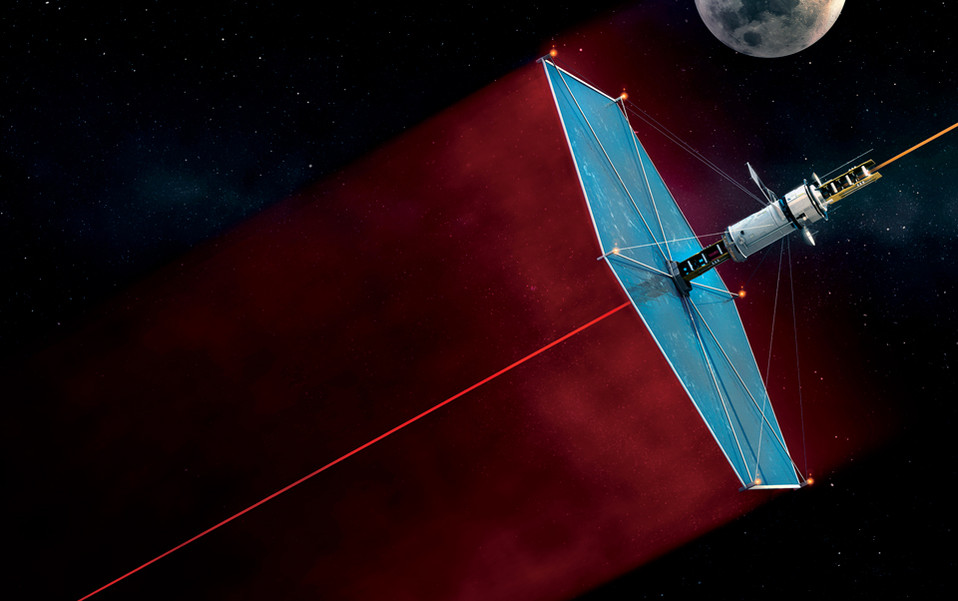
NASA’s Centennial Challenges Program: A Space Elevator
Space Elevator
In 2009 NASA’s Andrew Petro watched as a laser-powered robotic device climbed up a cable more than half a mile long above the Mojave Desert. A winner in the agency’s Centennial Challenges program—competitions designed to stimulate innovative research—the setup demonstrated the potential of wireless power transmission. That, along with work on superstrong materials, is creating fresh hope for a vision long the realm of science fiction: an elevator that can carry cargo, and possibly people, thousands of miles into outer space.
First described in 1960, the space elevator was also the subject of Arthur C. Clarke’s The Fountains of Paradise. Construction is still far from viable, but the basic theory is sound, says Petro. Both power beaming and strong tether materials—crucial aspects of the elevator concept—are featured in NASA’s contests and the annual Space Elevator Conference. Another boon was the successful production in 1991 of carbon nanotubes, one of the strongest materials known. But making them suitable for a tether remains a challenge. So why a space elevator at all? Once built, say advocates, it would enable high-volume shipping at a lower cost than rockets. And once that’s possible, the next stop could be colonizing Mars. —Luna Shyr
A Family Science Fest will be held on August 25 in connection with the Space Elevator Conference. Great to see these events including families to kickstart the imaginations of the public to become engaged in commercial space conversation.
Click here for more information on the 2012 Space Elevator Conference
Curiosity has Landed and Her View of Mars is Breathtaking
“Touchdown confirmed,” said a member of mission control at the laboratory as the room erupted in cheers at the touchdown of their $2.5-billion Mars Science Laboratory and Curiosity rover on the surface of the Red Planet, breaking new ground in the US-led search for signs of alien life. A similar roar of applause also went up in the 3-D Universe Theater at the Adler Planetarium in Chicago where I too watched the landing live with a front row seat in NASA JPL’s mission control.
“We are wheels down on Mars. Oh, my God!”
Describing the entry, descent, and landing of Curiosity as anything other than extremely nerve racking would be an understatement. Filming the mission control room allowed me to see the anguish underlying the stoic faces of many of the mission specialists who during the final minutes prior to MSL’s entry in the Martian atmosphere did a systems check. NASA’s Eyes on the Solar System allowed mission specialists to watch animated images of what should be going on in spite of the fact that they couldn’t see or hear MSL. An echo from MRO (Mars Reconnaissance Orbiter) that picked up radio signals from MSL kept mission control connected to MSL and the intermittent updates of MSL’s ‘heartbeat’ being heard was a underlying comfort to the EDL team.
“Seven Minutes of Terror” is how NASA chose to explain the sophisticated engineering operation that would get Curiosity safely on the surface of Mars. It was, in my own humble opinion, one of the better PR and marketing efforts of NASA. The Seven Minutes of Terror
video was well designed, written, and included actual MSL mission specialists describing each stage of entry, descent, and landing. It helped inform the world and remind us that taking risks in doing the unknown is the only way we can discover if something will be successful. Could the EDL have gone wrong? Yes in so many ways. It wasn’t just one event that had MSL mission specialists on pins and needles but several. MSL had to enter the Martian atmosphere and survive intense heat, slow down, eject the heat shield, perform a complicated balancing maneuver, open a parachute, fire jet engines, begin a crane procedure that involved lowered Curiosity with nylon cables, and finally placing Curiosity on the Martian surface with just the right touch to keep her from being damaged by too forceful a landing impact, tipping over, or any combination of these and other uncontrollable factors. The amazing fact; all of this was executed by onboard computer commands and it worked!
Amazing but true. There was no guidance from the folks in MSL mission control at all. They were as blind as the rest of us watching the NASA TV live stream. MSL is proof of the ingenuity of human engineering and the power of technology.
At 10:32 pm PDT (0532 GMT) cries of joys filled JPL mission control: “Hell, we did it!”
Yes guys you did! The following image sent from Curiosity is absolutely breathtaking!
Good golly miss MAHLI! New color pic from Mars Hand Lens Imager shows tan sands, no
@instagram req#MSL twitter.com/MarsCuriosity/…— Curiosity Rover (@MarsCuriosity) August 7, 2012
Here’s the Plan: NASA MSL/Curiosity Flight to Mars
In case you haven’t seen the NASA animations on the launch, travel, and eventual landing of NASA’s Mars Science Laboratory here it is. The rover will descend to the surface using jet pack technology then suspend from a tether and finally touch down on Mars. NASA has simulated the landing as much as possible and that video has been included here as well. Curiosity, once settled in her home in Mars’ Gale Crater, will search for evidence as to whether this spot on Mars ever was able to sustain life. In the most ambitious planetary exploration mission ever, Curiosity’s chemistry instruments will examine soil samples and send the results back to Earth. Who better to tell the story of Curiosity’s journey to Mars other than William Shatner.
Enjoy
NASA MSL/Curiosity Landing Event Schedule
Set your clocks! Live streaming on NASA TV will begin at 6 a.m. this morning and continue into the wee hours of the morning depending on where you live. It’s an event you won’t want to miss. I’ll be at the Adler Planetarium starting at 9:00 p.m.
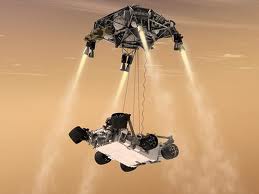
Curiosity’s decent towards the surface of Mars.
August 5, Sunday
6 a.m. – Replay of NASA Science News Conference – Mars Science Laboratory/Curiosity Rover Mission Status and Entry, Descent and Landing Overview (8/4) – HQ (All Channels)
7 a.m. – Replay of NASA Science News Conference – MSL Mission Science Overview (8/2) – HQ (All Channels)
8 a.m. – Replay of NASA Science News Conference – Mission Engineering Overview (8/2) – HQ (All Channels)
9 a.m. – NASA Television Video File – HQ (All Channels)
10 a.m. – 12 p.m. – Replay of NASA Social for the Mars Science Laboratory/Curiosity Rover Landing – HQ (All Channels)
12 p.m. – NASA Television Video File – HQ(All Channels)
12:30 – 1:30 p.m. – NASA Science News Conference Mars Science Laboratory/Curiosity Rover Pre-Landing News Conference – Rover Communication overview – JPL (All Channels)
1:30 p.m. – Replay of NASA News Conference to Announce New Agreements for Next Phase of Commercial Crew Development – HQ (All Channels)
2 p.m. – Replay of ISS Update (8/3) – HQ (All Channels)
3 p.m. – NASA Science News Conference Mars Science Laboratory/Curiosity Rover Pre-Landing News Conference – Rover Communication overview – JPL (All Channels)
4-6 p.m. – Replay of NASA Social for the Mars Science Laboratory/Curiosity Rover Landing – HQ (All Channels)
6 – 7 p.m. – NASA Science News Conference – NASA Science Mission Directorate – JPL (All Channels)
11 p.m. – Mars Science Laboratory/Curiosity Rover Landing Coverage of Entry Decent and Landing (Commentary #1 Begins 11:30 p.m.) – JPL (Public and Education Channels)
11 p.m. – Mars Science Laboratory/Curiosity Rover Landing Coverage of Entry Decent and Landing (Clean Feed with Mission Audio Only) – JPL (Media Channel)
August 6, Monday
NET – 2:15 a.m. – Mars Science Laboratory/Curiosity Rover Post-Landing News Conference – JPL (All Channels)
3:30 – 4:30 a.m. – Mars Science Laboratory/Curiosity Rover Landing Coverage and Commentary – Commentary #2 – (First Post-Landing Communication Session/Odyssey Downlink) – JPL (All Channels)
6 – 10 a.m. – Live Satellite Post Landing Interviews on the Mars Science Laboratory/Curiosity Rover Mission – JPL (Public and Media Channels)
12 p.m. – Mars Science Laboratory/Curiosity Rover Post-Landing News Briefing – Landing Recap and Sol 1 Outlook – JPL (All Channels)
7 p.m. – Mars Science Laboratory/Curiosity Rover Post-Landing News Briefing – Sol 1 Mid-Day Update – JPL (All Channels)
Countdown to MSL/Curiosity
It’s Friday and the anticipation for the landing of the biggest Mars rover ever is heating up! There are social gatherings all across the country with #NASASocials kicking off at JPL, NASA Ames, Kennedy and Johnson Space Centers, and others. NASA has launched several rovers to Mars over the last few years and the famed twins, Opportunity and Spirit, far outlived their mission lifeline. We lost communication with Spirit in May of 2011 but Opportunity is still going strong sending images back to Earth and allowing us to get a comprehensive view of what’s on Mars.
With MSL (Mars Science Laboratory) the Curiosity rover will take on an even more ambitious mission; looking for signs of life on the red planet! Wherever you may be on Monday, August 5 nearing the wee hours of the morning, make sure you are either with a group of space enthusiasts, with friends who share an interest in planetary exploration or are just curious about the breath holding landing and the images that will follow from the eyes of Curiosity.
Stay tuned as I cover and host events locally in the Chicago area. If you haven’t seen the NASA video 7 Minutes of Terror, catch it below and get ready to hold on to your seats for the actual landing of Curiosity.
This Week In Retrospect
This video, compiled by McLean Fahnestock, is a breathtaking reminder of the beauty of the Space Shuttle Program and the truth of whatever the mind of man can conceive and believe, he can achieve. All of the Shuttle launches are here including Challenger but watch the video understanding that on each of those launches human beings are in the Shuttle being carried on a large external tank full of fuel with two single rocket boosters on the side as it climbs its way into the heavens. Whatever you feel as you watch and after its over, realize that while the Space Shuttle Program has ended there is still unlimited possibilities for the United States to send humans into space and these innovations will be the next chapter in human space flight history.
This time last year I was in the company of thousands of people whose love for America’s space program echoed and cheered an engineering feat of human possibilities that allowed us to travel frequently into space to open new frontiers in discovery. For the thirty years that the Space Shuttle Program operated we were able to see astronauts riding atop a rocket in small capsules to a vehicle that looked more like an airplane and had the ability to return to Earth not by falling into the ocean but gliding to a landing time and time again. STS-135 was the last flight of the U.S. Space Shuttle Program and a year later I still have people comment to me that NASA has shut down. This is far from the truth of course but it is interesting how many people actually believe the only thing that NASA did was the Space Shuttle program and now that the shuttle will no longer fly NASA has just quit being.
NASA continues to innovate of course and for those space enthusiasts amongst us we know how much cool science and engineering is still going on but as most of my friends and I concur, there is a special thrill and awe to realizing humans are riding rockets into space, they spend time high above us during shuttle and ISS missions, and except for two untimely tragedies, all have returned to Earth to share their stories and experiences. Is it scary? All astronauts I have talked to as well as those I have heard tell their tales of Space Shuttle missions say yes. When I learned the process Shuttle astronauts go through in relation to family and loved ones it was surreal but grounding at the same time. We often don’t give much thought to how astronauts personally feel about going to space. Some of us think they are pretty lucky people while others think they are completely crazy. “You can die!” Yes, space is dangerous and when you commit to being an astronaut you also commit to the unknown and the probability that something can go wrong but you don’t dwell on the negative. I can just imagine how the astronauts who flew on STS-26 “Return to Flight” must have felt. Reading the engineering and flight preparation logs are enough to make anyone wonder why or how we kept launching Shuttles into space with so many problems. My first live launch, STS-133 was no different. There were problems that were identified and worked on, Discovery’s launch was rescheduled, and rescheduled, and rescheduled. Slips, as they are called, happen but the safety of the crew is what is most important and we didn’t mind waiting for the right and the safest possible launch.
I wish I had traveled to Florida to see more launches in my lifetime but sometimes there are things in our lives which take priority over others. I am thankful to NASA for giving me the opportunity to share with 150 other space tweeps the joy and sheer wonder of STS-133 during the NASA Tweetup event which has become known as the longest NASA Tweetup in history. I also thank all of those friends as well as the wonderful people at NASA gave us more than we ever could have bargained for in what was supposed to be a two day event but stretched into one that lasted 115 days.
To all my friends, students, parents and everyone else on the planet who shares a love for scientific discovery, education, and the ability to dream and dream big, this post is for you!
They Have to See It To Be It!

Working with the students at Corliss High School this year has been a truly wonderful experience. Located not far from Chicago Public School’s Fenger Academy, the once home of my NASA K-12 program, the Corliss students are faced with similar academic and social issues as most of the students who attend some of our academically challenged neighborhood schools. As we look at solutions to ensure all of our students get a quality education that includes rigor and offers opportunities to develop future career skills through engaging, hands-on projects and competitions. While talking to a colleague at Corliss, our conversation turned to a philosophy that I have believed in for many years as an educator. For our children to dream to become a computer programmer, astronaut, engineer, systems analyst, web designer, and all of the other STEM careers that are and yet to be available for them to purse, they have to see people who look like them, have shared similar experiences, and can be honest in explaining that STEM is rewarding but comes with hard work and perseverance.
This is why all of us who work to increase the number of historically underrepresented and underserved populations in STEM have to have a personal, vested interest in our young people and be willing to give back. That give back doesn’t have to be in tangible dollars and often becoming a mentor or volunteer with a STEM program can be one of the most rewarding experiences of your life. The NASA Great Moonbuggy Race was my latest endeavor and one of my most challenging but the students at Corliss stepped up to the plate and tackled the task. As I prepare for the 2013 competition, I am looking to bring more young STEM professionals to become part of my STEM efforts so the students understand that it is not an impossible dream. NASA did a feature story on me and my students and I am extending an invitation to those STEM folks out there to please join me in inspiring our young people in the upcoming 2012-2013 school year.
TRANSIT OF VENUS…The last viewing chance of our lifetime!
I’m sharing this information, received from my friend Vivian Hoette, Education Outreach Coordinator at Yerkes Observatory on viewing opportunites for Tuesday’s Transit of Venus event. If you can’t make it to a live viewing event, there are links below that you can visit to watch it online.
From the Yerkes Yoteach mailing list:
On June 5, 2012, Venus will cross the Sun marking an astronomical event you won’t want to miss! It is the last one in our lifetimes. (Next one is 2117.) Observing this event from multiple locations on Earth is how astronomers figured out the Astronomical Unit (AU, distance from Earth to the Sun). And, therefore the size of the cosmos! Now astronomers are using transits of planets across other stars to find exoplanets.
Big Foot Beach State Park (East Side of Lake Geneva) and Yerkes Observatory are hosting viewing events for the Transit of Venus. We will have sunspotters, solar scopes, solar filtered telescopes, and eclipse glasses for sale.
Preserve your eyes! VIEW SAFELY – DO NOT LOOK DIRECTLY at the Sun, and NEVER EVER through a telescope Unless it has a SOLAR FILTER over the OBJECTiVE (large opening of the telescope).
You can see Venus cross the Sun from about 5:04pm to sunset in the midwest. Our events begin at 4pm and continue through sunset. Attached here are a couple of flyers that we made for this event.
You may download these and give them to your students or post them at school, or modify them to meet your needs. We also have lots of eclipse glasses for sale at Yerkes ($2) or in bundles for schools (limited supply) at $1 each if you pick them up from Yerkes.
If you would like some advice or help setting up a way to view the transit and sun safely, please contact us and we will try to help. If you are in the area, and would like to help out at Yerkes or another location (such as the Township Park in Delavan at the east end of the lake, or at the Duck Pond in Fontana, we can loan you a solar scope that projects a 5 inch image (approx) of the sun to see sunspots and the Venus transit.
Though many will be able to see the transit in eclipse glasses, a magnified projected view or telescope solar filtered view will be best. (Solar filters must be put in place on the objective (large) end of the telescope. We have some solar filter film (limited supply) ordered that will arrive on Monday, in case you are really interested in making your own solar filter. Please let us know and be at Yerkes on Monday to build it.)
Webpages to help you out….
Register for Big Foot Beach State Park or Yerkes Observatory Events http://astro.uchicago.edu/yerkes/venus (If you want to help out you can let us know in the comments area.)
Event Locations http://venustransit.nasa.gov/2012/transit/event_locations.php
2012 Transit of Venus — Shadows on the Sun (by NASA) http://sunearthday.nasa.gov/transitofvenus/
NASA page http://venustransit.nasa.gov Live webcast and everything about the Transit of Venus
Transit of Venus (by Chuck Bueter) www.transitofvenus.org
Transit of Venus (by Astronomers Without Borders) http://transitofvenus.nl/wp/
Yerkes information page about the Transit http://astro.uchicago.edu/yerkes/sun/
Freinds of Big Foot Beach State Park http://fbfbsp.org/transit/
Safe Solar Viewing http://sunearthday.nasa.gov/2012/transit/viewing.php
Sun Funnel http://transitofvenus.nl/wp/observing/build-a-sun-funnel/ (Wehave a limited supply of the rear projection screen material. Pay attention to the eyepiece focal length needed listed in a chart in this document to put in the projection funnel; you will need your own eyepiece.)
Kepler Explanet Transit Hunt http://kepler.nasa.gov/multimedia/Interactives/keplerFlashAdvDiscovery/#
Hubble to use Moon as a Transit Mirror http://www.nasa.gov/mission_pages/hubble/science/transit-mirror.html
Yerkes & Big Foot Transit Poster http://astro.uchicago.edu/yerkes/img/sun/Venus_Transit.jpg
Space X….Launching the New Frontier of Commercial Space
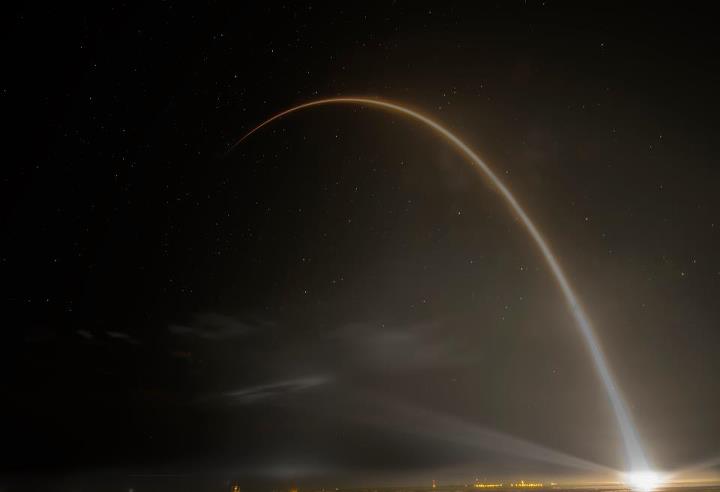
SpaceX launches Falcon 9 into space (Photo credit James Fink)
There are some amazing sights on this planet but I still find the launch of a space vehicle to be an event that always leaves me in awe of what we are capable of engineering. SpaceX has successfully launched the Falcon 9 with a Dragon capsule carrying supplies to the International Space Station. This picture of the rocket taken early Tuesday morning, May 22, with the stars as a perfect backdrop is the beginning of a new era of space flight. The goal of the mission is for the Dragon capsule to dock with the International Space Station and deliver supplies to the astronauts living high above Earth. Keep your eyes to the sky and you might be able to see not only the ISS pass by but the Dragon as well.